

How CBT Changes Unhelpful Thought Patterns
Your manager walks past your desk without saying hello. Before you have taken a breath, the thought arrives: “She is angry with me.” Your chest tightens, and you spend the afternoon avoiding her. CBT works on exactly this loop. The National Institute of Mental Health describes it as learning to notice automatic thoughts, then questioning the untrue or unhelpful ones. These thoughts move so fast they feel like facts.
At Blue River, we slow the thought down with you. We ask what you actually saw: she was carrying a laptop and a coffee, and she was late for a meeting. Then we ask what you would tell a friend who had the same thought. Clinicians call this cognitive restructuring. You end up with a thought closer to the facts, even when the facts are hard.
CBT can also start from the other end of the loop by changing what you do first. Behavioral activation means scheduling small, specific activities on days when low mood makes everything feel pointless. Graded exposure means facing a feared situation one manageable step at a time. At Blue River, our cognitive behavioral therapy in Minnesota is skills-based from the first session.
What Conditions Can CBT Help Treat?
We use CBT for anxiety and depression, PTSD and trauma, and OCD. For anxiety, the work often targets all-night worry and a week shrunk by avoidance. For depression, it targets the harsh inner voice and the pull to cancel plans. Many people come to us with more than one of these at once. We build one plan around what you are facing.
Our CBT for addiction works with whatever you have been using. The list includes alcohol, opioids such as fentanyl and heroin, cocaine, meth, benzodiazepines, cannabis, and misused prescriptions. If you mix substances, like alcohol with cannabis, we work on the whole pattern in one plan. Your therapist looks at what each episode of use was meant to solve, then builds other ways to handle it.
A family dinner ends in an argument, and the thought arrives: “I ruin everything.” Your mood drops for the evening, and a drink starts to look like relief. By morning, the mood is heavier, and the thought is louder. Your therapist works on the thought from both sides. The drink and the low mood come up in the same session because one thought feeds both.
What to Expect During an Individual CBT Session
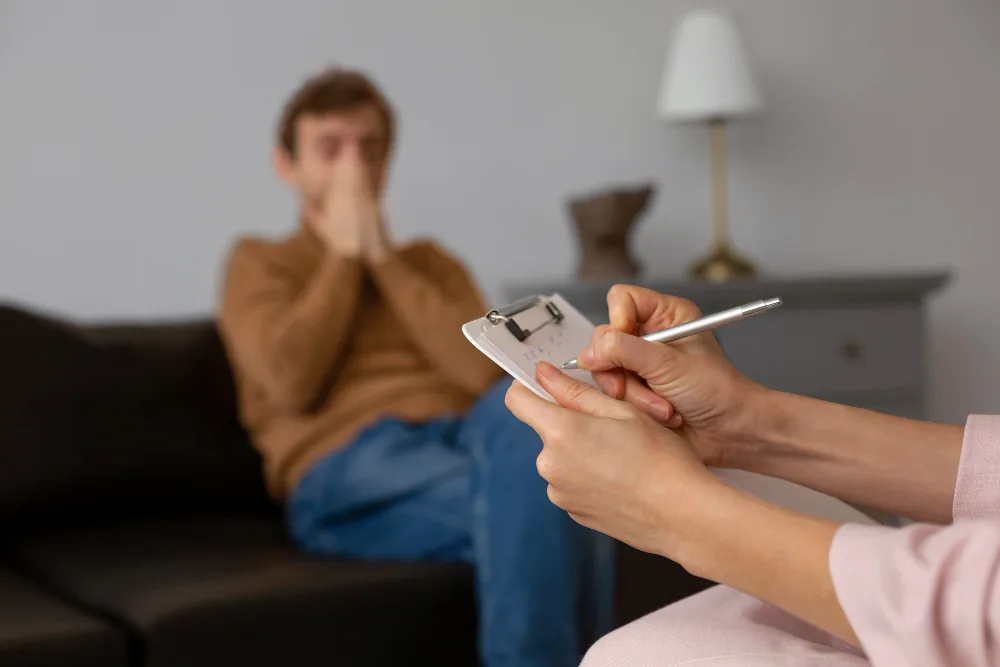
Individual CBT follows a clear order, so you always know what is coming. You start with a short check-in on your week, covering mood, sleep, and any urges. Then you and your therapist review last week’s practice task. You note what worked and what got in the way, so you can use the information next time.
Next, you set the agenda together by choosing one situation from your week. It might be an argument with a partner or a Sunday night spent dreading Monday. Most of the session goes to the one moment you picked. You slow it down, look at the thought behind it, and rehearse a different response in the room.
Before you leave, you and your therapist agree on a small practice task for the week ahead. Most weeks, the task is small enough to fit around your life. It might be logging your mood for three evenings or trying one new response with a friend. Next week, you bring back what happened, whether it went smoothly or not.

What a CBT Thought Record Looks Like
A thought record is a core worksheet in CBT for anxiety and depression. It turns a fast, blurry moment into steps you can see. You fill it in soon after a thought hits, while the details are fresh. Here is how one might look after a single unanswered text message.
- Situation: A close friend has not answered your text in two days.
- Automatic thought: “I’ve lost her for good.”
- Feeling: Sadness, heavy enough to skip dinner.
- Evidence for: Her reply is late. You canceled on her last month.
- Evidence against: She has answered every message before. She is traveling for work this week.
- Balanced thought: “I don’t know why she has not written yet. Silence is no proof I lost her.”
- Action: You eat, go for a walk, and send her a short, warm message.
The jump from two quiet days to a lost friendship is a thinking trap, or cognitive distortion, called catastrophizing. Writing it down slows the jump enough for you to see it and choose what you do next. Other common traps include all-or-nothing thinking and mind reading. Your therapist helps you spot the ones you fall into most often.
How CBT Helps You Plan for Cravings
With CBT for addiction, you build your craving plan before you need it. Your plan maps out four steps in order: the high-risk situation, the thought it triggers, the craving, and your chosen response. Writing it ahead of time lets you think clearly. Once a craving hits, rational thought is much harder to reach. You keep the plan somewhere you can find it fast, like your phone.
Say it’s payday Friday. Your paycheck just landed, and your coworkers are heading to the bar. The thought arrives right on cue: “I worked all week. I earned this.” The urge builds on the drive home, and this is where your plan takes over. You text a friend before you leave work. You take a route that skips the liquor store. You keep a refusal line ready, and something as plain as “I’ve got plans tonight” works.
Self-monitoring fills in the gaps between sessions. You track when cravings show up and what happened right before them. Patterns start to appear, like a certain day of the week or a certain person. In session, your therapist reviews the plan with you and adjusts whatever didn’t hold up.
How CBT Works Across Our Levels of Care
Our cognitive behavioral therapy in Minnesota uses the same tools in every program. What changes is how often you practice them with support. Your starting level depends on how much structure you need right now, and it can shift as your needs change.
PHP, our full-day program, meets five to six hours each weekday. Your day includes group, individual, and skills-based therapy. You can learn a skill in a morning group and test it again before you head home. IOP scales back to about three hours of group, three to five days a week, plus individual sessions. The days in between give you room to try your craving plan or thought record on your own.
OP sessions are weekly or biweekly, and you schedule them around work and family. OP fits best if you already have a foundation of skills and want steady support as life gets busy again. If getting to us is hard or you value your privacy, our telehealth services let you do your CBT work from home. Online or in person, every session follows the same steps, including the check-in and the homework review.
Group CBT works differently from individual therapy. Clients share what came up during their week, and the group works through it together. You might hear someone untangle a thought pattern you recognize from your own head, then practice the same skill yourself. With your permission, we can bring your family in through family therapy. They get to see firsthand what a thought record or craving plan looks like.